


The restaurant data platform for your entire team
.png)
Menu simplification has been a recurring headline in restaurant conversations over the past few years. Operators have cited smaller menus as a way to reduce complexity, improve execution, and focus on the items that matter most. In January 2025, Starbucks CEO Brian Niccol said the company's menu had become "overly complex" and announced plans to cut roughly 30% of its food and beverage items. Chili's CEO Kevin Hochman has similarly described the chain's strategy as "doing fewer things a whole lot better," with the brand removing about a quarter of its menu since 2022.
Some industry analysis has gone a step further, suggesting that simpler menus may also translate into stronger performance. Aaron Allen & Associates, for example, reports that chains that have simplified their menus have outpaced their peers in sales growth.
With brands like Dave’s Hot Chicken and Raising Cane’s regularly making headlines for their rapid growth and focused menus, we wanted to see what the data could tell us about the relationship between menu size and restaurant performance.
We decided to test that assumption by comparing small-menu and large-menu brands on Bikky. We found that the data tells a more complicated story, and ultimately raises a different question about how operators should think about menu strategy.
We pulled monthly transaction and revenue data for a set of brands on Bikky, comparing brands with smaller menus against brands with larger menus. To determine menu size, we used entrée counts, the number of distinct entrées each brand's registers recorded in a typical month. The analysis covers September 2023 through August 2026, giving us 24 comparable months of year-over-year growth across that three-year period.
To keep the comparison fair, we only included restaurants open in both the current month and the same month a year earlier, past their opening and comp period, and we weighted every brand and month equally, so a large chain with hundreds of locations doesn't carry more influence than a brand with just a few.
A year ago, small-menu brands were growing meaningfully faster than large-menu brands. The gap was about five percentage points in both transactions and revenue, with small-menu brands ahead on both. Both groups raised their average check by almost exactly the same amount over the 24 months we analyzed, so the difference was driven by traffic, not check size.
But the small-menu advantage didn't last. Over the past twelve months, the gap narrowed to roughly one percentage point on both transactions and revenue. By early 2026, the two groups weren't just close, they had converged.
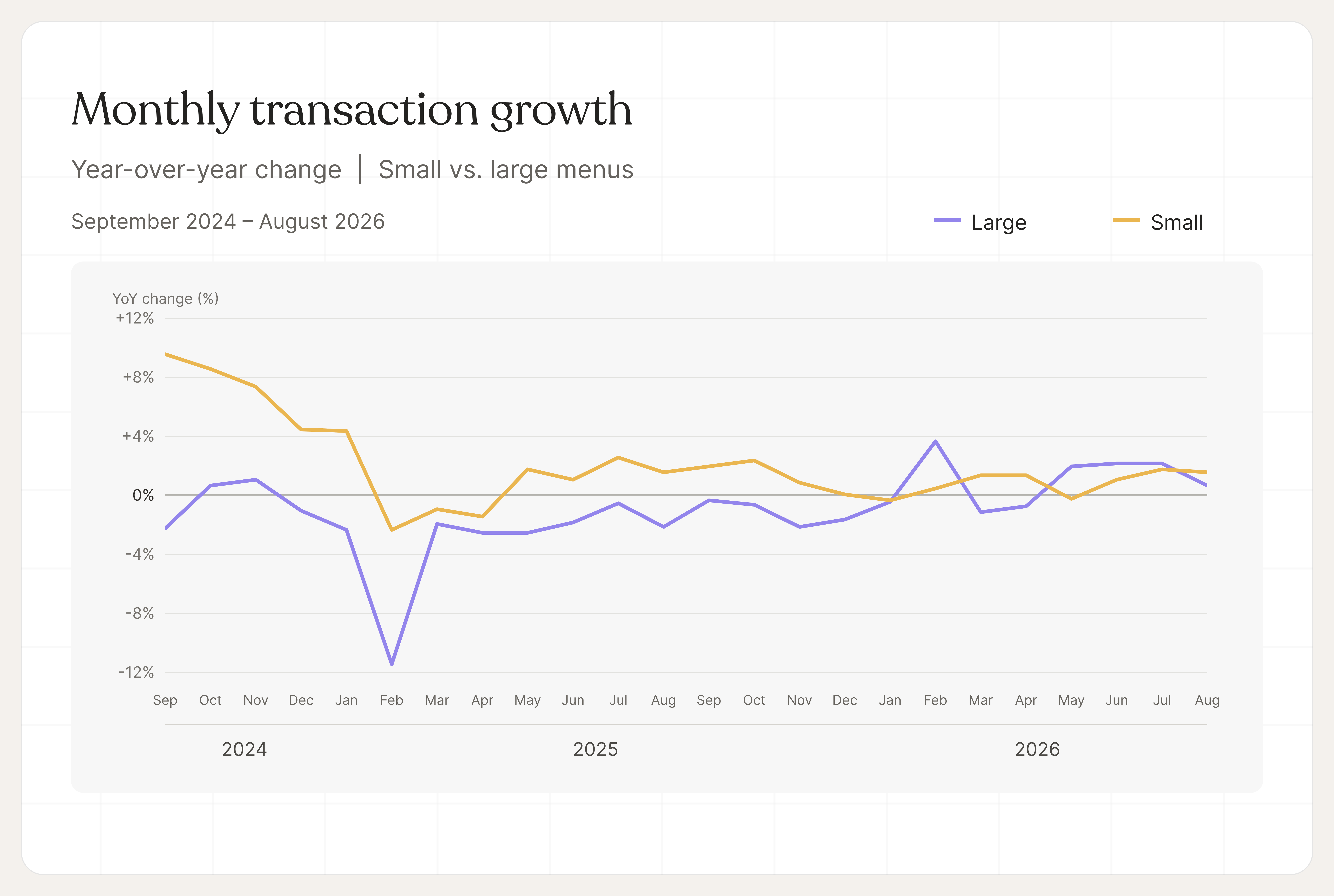
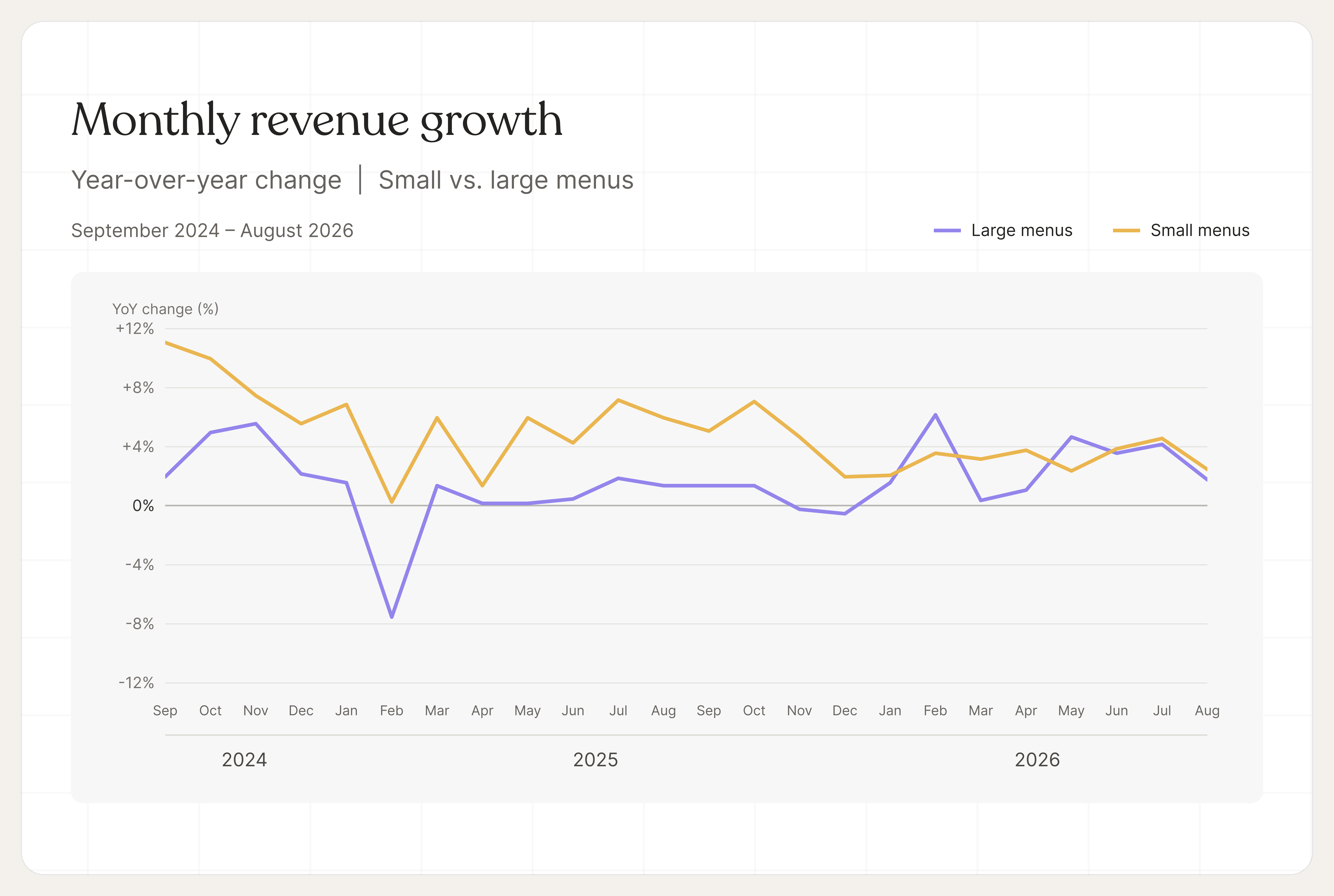
So while we can see the two groups converging, the data doesn't give us a clear explanation for why. Some large-menu brands may have steadied, while some small-menu brands may be moving past their earlier growth, but we can't distinguish between those explanations from this analysis alone.
What surprised us more was how differently brands performed, even within the same menu-size group.
Of the small-menu brands we included in our analysis, the fastest-growing brand added transactions about 40 percentage points faster than the slowest-growing over the last twelve months. Across the group, some small-menu brands were growing while others were declining, creating a much wider range of performance than we saw in the large-menu group.
Large-menu brands looked more consistent by comparison. Nearly all of the brands we analyzed grew faster over the last twelve months than they had the year before, generally by a few points, while only a smaller number declined. Their spread between the fastest- and slowest-growing brands stayed at roughly 8 percentage points throughout.
Taken together, the brand-level results showed that menu size didn't explain as much of the difference in performance as we anticipated. We went into the analysis expecting smaller menus to perform better overall, and that was true earlier in the period we analyzed, but the more recent data showed volatility among small-menu brands. Large-menu brands, by comparison, tended to perform more consistently and stay more closely clustered. That wasn't what we expected to see, and it added an interesting storyline to our analysis.
Along the way, we came across research approaching the topic from a different angle: how menu sizes have changed across the industry over time, rather than how brands with smaller and larger menus compare. Datassential reported that average menu sizes have grown by roughly 23% over the past two decades, including a 20% increase among QSRs. Technomic similarly found that QSR core menus have grown 6% since 2021, even as brands continue to introduce and rotate limited-time offerings. Industry-wide, menus have continued to get larger, not smaller.
In reviewing earnings reports, we found that individual brands are making choices in both directions depending on their goals. Chili's and Papa John's have talked about removing items to reduce complexity and sharpen execution. Domino's and Wingstop have expanded their menus as part of broader growth strategies. CAVA has added items while emphasizing that it wants to avoid adding operational complexity.
Small-menu brands were growing faster than large-menu brands through 2024 and into 2025, but that advantage has since largely disappeared. Today, the two groups are growing at about the same rate, while the differences between individual brands, regardless of menu size, are much larger.
This doesn't mean menu size has no bearing on growth, just that the relationship is messier than a simple bigger-is-worse or smaller-is-better story. The brands growing fastest aren't all operating with small menus, and the brands growing slowest aren't all operating with large ones.
For operators, and what we saw in earnings reports, menu changes make the most sense in the context of what a brand is trying to accomplish. Adding or removing items might be intended to bring in new guests, increase visit frequency, drive attachment, or encourage more guests to come back. Brands on Bikky monitor metrics like new guest acquisition, visit frequency, attachment rate, and return rate to see how those decisions actually show up in guest behavior.
The conversation about menu size isn't going away any time soon. Whatever your menu strategy, keeping a consistent read on how it shows up in guest behavior is what can help make those calls with confidence.
The restaurant data platform for your entire team