


The restaurant data platform for your entire team
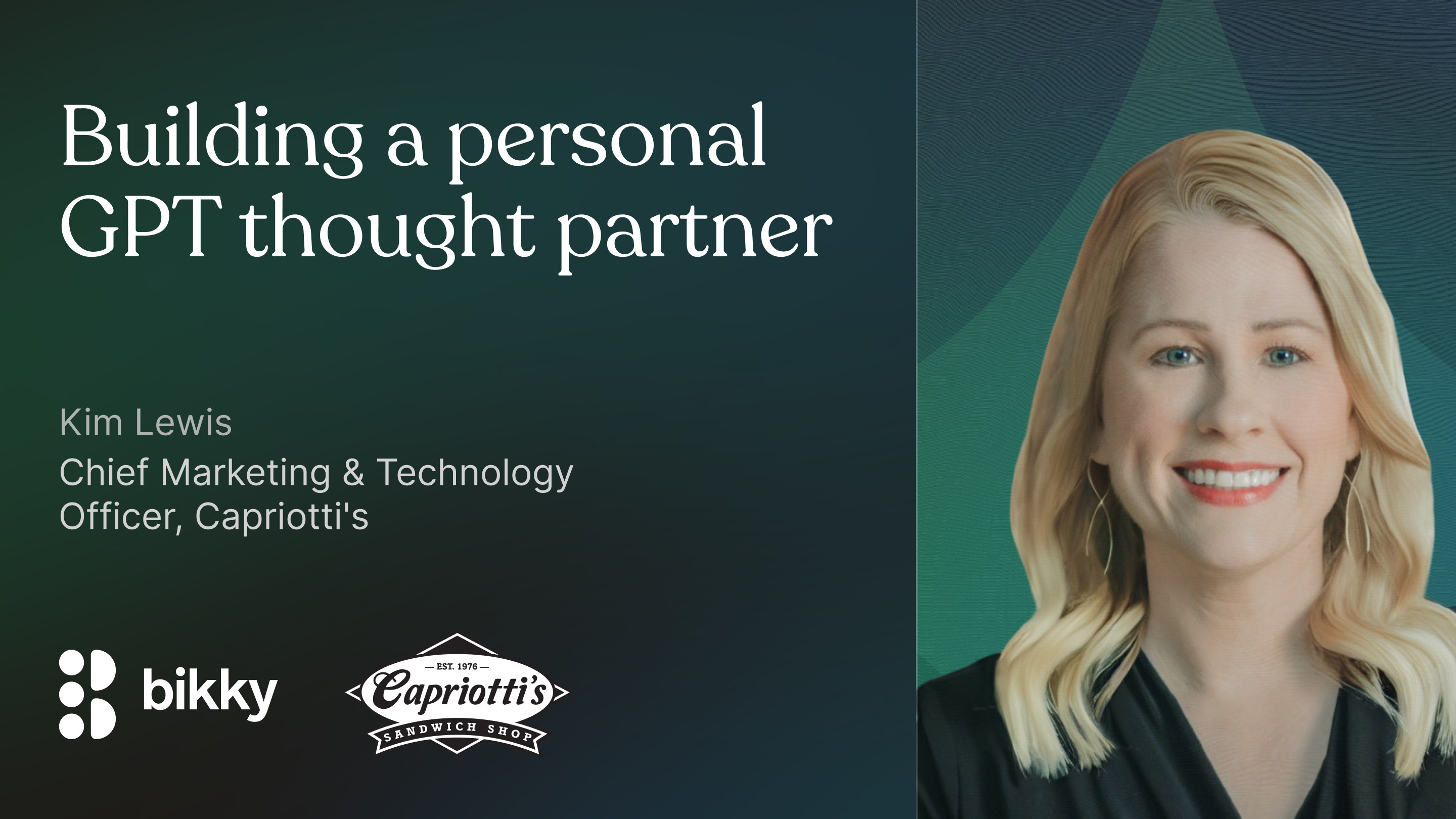
Part of Bikky's AI Summer School — a series where restaurant operators share how they're using AI day-to-day, what tools they're using, and what it's done for their brand.
In this AI Summer School session, Bikky CEO Abhinav Kapur sat down with Kim Lewis, CMO and CTO of Capriotti's Sandwich Shop, to walk through how she built a personal AI thought partner to help her work through her ideas, communicate efficiently, and pressure-test decisions.
Kim has spent more than a decade on the MarTech side of the restaurant industry, watching pitches evolve from machine learning to AI in vendor after vendor's roadmap. It gave her an early read on AI, but not a clear entry point of her own.
When models like ChaptGPT and Claude started gaining traction, most of what she heard at industry conferences was about enterprise-scale automation, replacing workflows and running entire departments through AI. It made her feel like she was too far behind to start.
A conversation with a peer in the restaurant industry changed that. He'd built a custom GPT for himself, not to automate his job, but to think and lead more clearly. Kim went back to her hotel room that night and started building her own version.
Enter Kimbot: a custom GPT trained on how she thinks, makes decisions, and communicates, built to compliment and sharpen her leadership skills.
Kim generated Kimbot in four steps, and recommends following them in order rather than trying to do all four at once.
Step 1: Write your leadership code. Lay out the operating principles you want every idea run through, custom instructions the model checks new ideas against. One of Kim's: any major initiative has to tie to at least two strategic priorities. She built the list by having the GPT interview her until hours of conversation distilled into something concise.
Step 2: Pick one use case and go deep. Choose strategy, communications, decision-making, or personal reflection, get that one working well, then move to the next.
Step 3: Feed it your actual thinking. Presentations, emails, transcripts of talks you've given. Kim fed hers a year of franchisee marketing updates, corrected it line by line, then had it write up a voice and style guide from that: no emojis, no corporate-speak, rewrite anything that sounds generic.\
Step 4: Tell it your story. Where you grew up, how your career progressed, what shaped how you lead. Kim recorded herself on a walk, letting the GPT interview her about her own background, and fed the transcript back in.
Kim uses Kimbot in her day-to-day for tasks like triaging long emails down to what actually needs a response, turning a meeting transcript into a ready-to-send survey, and drafting franchisee updates close enough to her own voice that she only needs to change a few words before sending.
She's also turned to Kimbot for more complex communication use cases, like a recent decision to consolidate Capriotti's local marketing toolkits down to fewer programs. Kim wanted to make sure the change landed well with franchisees, so she asked Kimbot to think through their likely concerns and how to frame how she communicated the decision.
Kimbot reasoned that franchisees would be more concerned about feeling like they were losing control over their local marketing than having fewer program options. It recommended announcing the change on Capriotti's monthly franchisee webinar instead of by email. Kimbot also offered suggestions on how to navigate feedback from franchisees following the announcement.
What made Kimbot effective in this scenario was that it had been briefed on how Capriotti's franchisee relationship actually works: what forums exist, what's already been communicated, and what a change like this implies given the local marketing strategy to date. A generic AI tool could draft a communications plan. Only one trained on the specifics of this business could predict that franchisees' real concern would be losing control over their local marketing, not the number of programs on offer.
Kim shared Kimbot with members of her leadership team she'd been working on strategic planning with. Her team uses it to catch questions or gaps they might not think to raise on their own, running ideas past it and asking things like "What would Kim say about this?" or checking how a plan lines up with the company's strategic priorities, before ever bringing it to Kim directly.
The difference is clear: work that used to land on her desk 25 to 30 percent baked now regularly shows up 75 to 80 percent of the way there, and the team has told her they appreciate having a first pass before sending things her way.
The time Kim spent training Kimbot on how she thinks and communicates is paying off downstream, in decisions made faster and with less friction, for her and now for her team too.
Kimbot is an example of scaling strategic thinking with AI, not just for one person, but in a way that made the benefit visible to her team and the rest of the organization. The version built for one leader's judgment became something a whole team could learn from.
Kim built the original version of Kimbot in ChatGPT, but Capriotti's has since standardized on Claude as its enterprise AI, and Kim is in the process of migrating everything over so she can build on Claude Cowork's automation capabilities. The next step, in her words, is turning the enterprise knowledge she's built up into automations that can act on some of that thinking without needing a person to evaluate every step.
The restaurant data platform for your entire team